Development diary
Capital Works
How a factory opening date became a prospectus, a flotation and a small model of industrial capital.
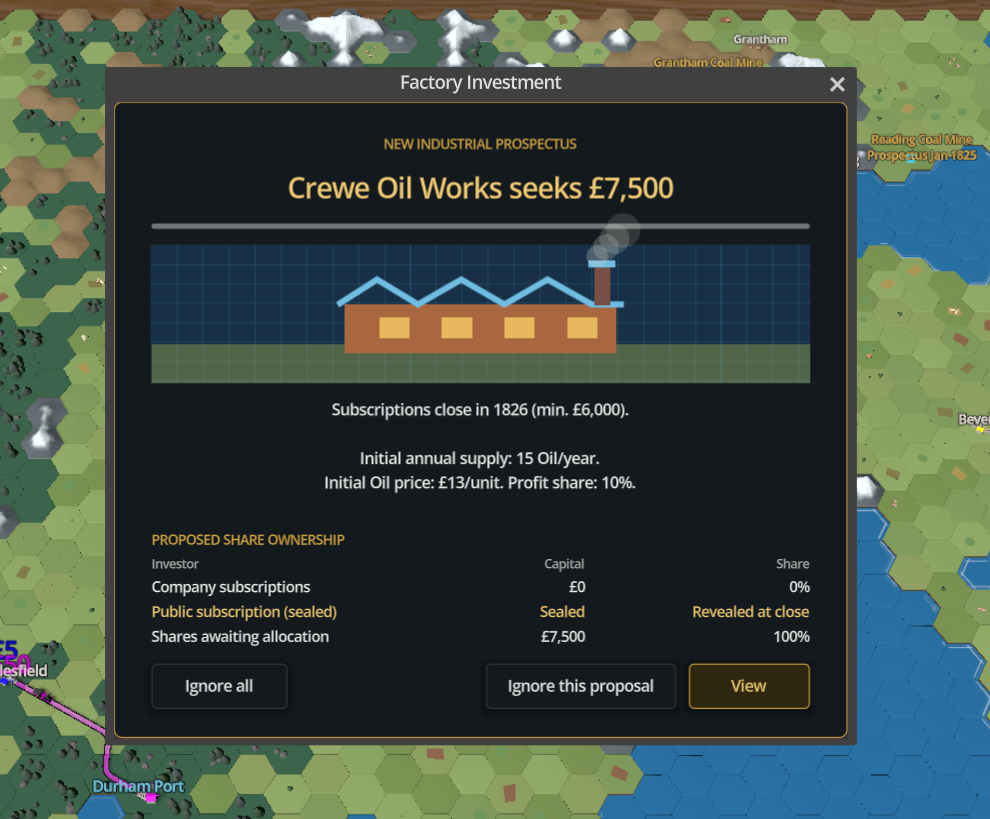
Factories used to open because the calendar said so.
That was perfectly functional. A goods works could be unavailable in 1820, the years would pass and, on the appointed morning, it would appear ready to receive coal and steel. It gave the railway network new work to do and made the world change over time.
It also felt as though somebody else had built half of the economy whilst we weren't looking. We'd not notice the map changing and although it gave the AI's a little unfair advantage, I want the player to feel like the world is alice.
Rail Capital spends a great deal of time asking where money belongs. Players have their own cash, companies have treasuries and cargo has a purchase price. Having gone to all that trouble, allowing a major industrial works to materialise for free was becoming harder to ignore. If a new works was worth connecting to, somebody ought to have raised the money to build it.
So we wrote a prospectus.
A simple idea with rather a lot inside it
The first version of the idea sounded harmless: announce a proposed works, let railway companies invest and open it if enough money is raised.
Immediately, there were questions.
- How much should the works cost?
- Why would one works be more attractive than another?
- What does an investing railway actually own?
- How does it earn a return?
- Can one rich company simply buy the whole thing?
- What happens if the player ignores it?
- What happens if everybody invests too much?
- What happens if nobody can afford it yet?
The dangerous answer was to build an entire second stock market for industrial companies. It would be wonderfully detailed and almost certainly turn a railway game into an accountancy game every time a factory appeared.
We wanted enough financial machinery for the decision to feel real, but not so much that players needed a new career.
Valuing the proposal
The starting point is the business the works expects to do.
For a processing works, the game looks at the market value of its required inputs, the value of its output and its production capability. A modest works making a narrow margin asks for less capital and offers a lower royalty. A larger, more productive works making a premium product needs more money, but offers investors a greater share of the value it creates.
That gave us three broad royalty bands:
- 7% for a modest projected margin;
- 10% for a strong projected margin;
- 13% for a premium projected margin.
Raw-material producers needed a related but different calculation. A coal mine does not turn two inputs into a more valuable output, so its target is based on its supply rate, capability and the value of the resource it will bring to market. This also gave us a reason to stop pretending that a coal-producing town and a colliery were the same thing. Mines, oil works and steel works are now proper industrial sites, with their own locations, output and prospectuses.
The result isn't intended to be a company valuation simulator. It is a model that makes the important differences visible: scale, margin, capital required and the price investors receive for taking the risk.
Subscribing without knowing the answer
When a prospectus opens, railway presidents can commit company treasury to it. This is deliberately company money rather than the player's personal cash: the railway is making a strategic investment in an industry it may later serve. I haven't come to a conclusion yet as to whether players can invest in these too. It gets complicate because ideally I didn't want a player to own more than 50% of a factory, to keep things fair against richer companies. But if it's players plus their associated companies investing - how do the maximums work?
A prospectus remains open for two years and must reach 80% of its funding target to proceed. No single railway may subscribe for more than half of the target, so a prosperous company can strongly support a project without guaranteeing it alone.
The public market subscribes as well, but its appetite is sealed until the deadline. It is influenced by the quality of the venture, a small deterministic variation and the confidence signalled by railway subscriptions. The player can know that a proposal looks attractive; they cannot know the exact public cheque in advance.
That uncertainty is important. If the public total were visible, the decision would be reduced to filling in the precise missing amount at the last moment. With sealed demand, a company must decide how much capital it is genuinely willing to risk.
Subscriptions leave the railway treasury immediately. Presidents use a slider to set a commitment between zero and 50% of the target, and reducing that commitment refunds the difference straight away. This means the decision can be revised as track projects, train purchases and other demands on the treasury change.
At the deadline, one of three things happens:
- The flotation reaches its minimum and enters construction.
- It is oversubscribed, ownership is allocated proportionally and the excess is refunded.
- It fails, every company subscription is returned and the promoters may try again three years later.
After a second failed flotation, the site is abandoned. Not every proposed works is destined to exist.
From paper to bricks
Funding a works does not make it appear instantly. A successful flotation spends at least a year under construction, and funded developments reserve opening dates at least two years apart.
This solved three problems. It preserved the sense that something substantial was being built, it stopped several successful proposals landing on the map at once and completely rearranging the freight economy overnight and perhaps most importantly, it gave the player a respite from factories begging for money.
We then made the schedule respect the industrial chain. A processing works will wait until both of its required raw materials are available. Raw-material prospectuses are prioritised ahead of processors, and generated games begin with only a small number of producers already open. The player gets time to establish a basic railway before being asked to finance every mine, oil works and factory in the county.
Product-delivery scenarios can bring a relevant prospectus forward, but they don't magic the building into existence. The works still has to raise its capital and survive construction. Newly surveyed territory follows the same rules, so expansion reveals potential industry rather than free industry.
What the investors receive
An open works charges a royalty when a railway collects its output. The royalty is based on the current market value of the product, so investors participate in the success of a valuable industry rather than receiving an arbitrary fixed payment.
At year end, 75% of the royalty income is distributed to the investing railway companies in proportion to their allocated capital. Public investors receive their share outside the railway economy. The remaining 25% stays with the works.
Retained profit is useful rather than decorative. Processing works retain part of their royalty income and can eventually fund capability upgrades, increasing processing and storage capacity for every railway using them. Successful industrial investment can therefore produce returns while gradually strengthening the freight network.
Ownership also survives the less pleasant parts of corporate life. Investment interests transfer when railway companies merge. If a company is liquidated, its interest returns to public ownership. The factory is connected to the rest of the company system rather than living in a special menu with its own convenient rules.
Making it usable
The financial model worked before the feature worked.
Our first generated worlds were enthusiastic prospectus writers. Several proposals arrived close together, notices competed with auctions and players were asked for thousands of pounds before their first railway had become reliably profitable. The calculations could be correct while the experience was completely unreasonable.
I've taken a series of steps to calm it down:
- Generated games wait before the first prospectus appears.
- Proposals are assigned deterministic months instead of all arriving in at the start of a year.
- New prospectuses are spaced at least three months apart.
- No more than two may be live at once.
- Only the next proposal in each industrial category is shown in the pipeline.
- A proposal can wait for a viable human-controlled company treasury, but only up to a hard limit so the economy cannot stall forever.
- The opening company auction blocks proposals, while later Auction House sales no longer cause a prospectus to disappear unnoticed.
- Funded works reserve staggered opening years.
- Raw-material supply scales for later openings so a mine floated in 1880 is not producing for an 1820 economy.
The interface needed the same treatment. The Factories overview now shows the target, minimum funding, royalty, capability, closing year and known company subscriptions in one place. Public demand remains visibly sealed rather than merely absent. The commitment control previews both the treasury cost and any refund before applying it.
Prospectus notices include the actual investment terms, and a View site button moves the map to the proposed location. Players can filter the overview to proposals, move directly from a notice to the funding controls and see the final company and public ownership when the flotation closes. AI companies assess and subscribe to proposals too, so this is part of the shared economy rather than a private decision presented only to the human player.
I also removed some notifications. Every new works opening felt important while we were building the system; several interrupting the player over a long game felt like paperwork. The overview and the map can carry routine information. Pop-ups are now reserved for decisions and meaningful results.
Testing the prospectus
This feature has produced an unusually long list of tests because almost every rule affects money, timing or both.
We now test subscription caps, refunds, failed flotations, retries, abandonment, oversubscription, final ownership, construction spacing, dependency delays, monthly scheduling, treasury readiness, concurrent-proposal limits, opening auctions, annual auctions, producer placement, late-game supply, map saving, multiplayer commands and mergers.
That list is less glamorous than a factory illustration, but it is what lets us put company treasury into a two-year process without quietly losing it during a save, merger or failed proposal.
The outcome
Works no longer open because a date in a file says they should. They begin as an economic proposition: a site, a recipe or resource, a capital requirement and an uncertain group of investors.
Railway presidents must decide whether they are financing useful traffic, helping a rival's network or simply buying a future royalty stream. They can support an industry they intend to serve, invest in one somebody else will serve, or keep the treasury for rails and locomotives and hope the public carries the flotation.
Most importantly, the world can now fail to develop exactly as planned. A works can be delayed, oversubscribed, improved by its own profits or abandoned altogether. That gives each map a little economic history of its own.
Whether players will calmly read the prospectus or put half the company treasury into the first exciting steel works they see is, of course, now a matter for playtesting.