Development diary
The Railway's Postbag
How a quiet spell between railway projects became a stream of letters, special trains and multi-stage campaigns.
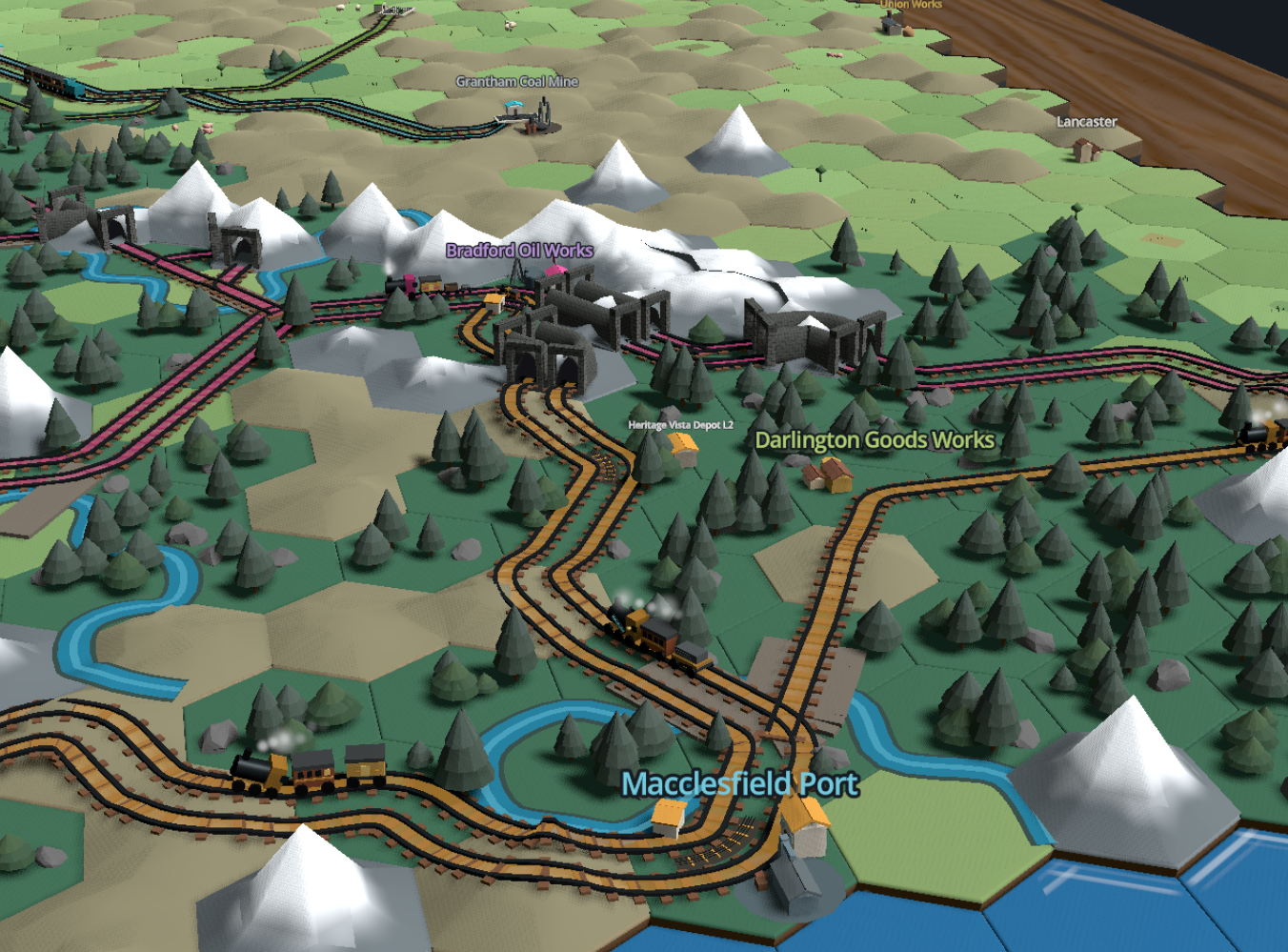
There is a point in many railway games when the player has done everything sensible.
The track has been laid, the stations are open and the services are running. The next expansion is clear, but the company does not yet have the money to build it. The optimal decision is therefore to increase the game speed and wait.
That is not necessarily a problem in small doses. Watching a railway operate is part of the pleasure of building one. It becomes a problem when the rhythm of the game settles into pause, build, unpause, wait, repeat. Rail Capital has plenty of interconnected systems, but they were not always giving the player an immediate reason to engage with the railway they had already built.
The answer arrived by post!
A request, not another contract
Rail Capital already has haulage contracts. They are substantial commercial commitments, they occupy an operating slot and they form part of a company's planned business. I did not want requests to become smaller contracts with a different heading.
Instead, requests are short opportunities sent directly to the player. A government department may need an urgent consignment carried. A dignitary may require an express train. A town committee may offer support for a new connection. They use the network, trains and decisions already present in the game, but ask the player to use them in a particular way.
Three standalone request types formed the starting point:
- carry a VIP directly between two locations;
- deliver a reserved freight consignment;
- connect two places and complete a passenger journey between them.
These do not consume an operations slot. A request should give the player something interesting to attempt during an ordinary game and not force them to dismantle the timetable.
Special passengers and cargo also sit outside the normal local economy. A War Department consignment does not empty a town's warehouse, while its arrival does not consume the destination's ordinary demand. That lets us ask for a precise delivery without quietly disrupting all the services that were already using those supplies.
The express wording needed more care than expected. A VIP train must travel to its destination directly, but it may pass through other locations without stopping. Saying that a place had to be the train's “next call” made a perfectly valid through journey sound impossible, so the letter now explains the rule in railway terms.
You've got mail
Requests arrive in the Mail panel rather than another permanent window. A large envelope drops from the top of the screen, bounces at the height of the panel and slides into the postbag. It is deliberately reserved for requests; routine prospectus notices do not get to announce themselves with the same flourish.
The first letter also introduces the system. Once a company has made its first new connection, a small You have mail! message points the player towards the Mail panel if it is closed. Tutorials suppress requests entirely because a lesson about building a station does not need the War Department arriving halfway through it with a more urgent opinion!
There are three request slots. An offered request can be accepted or declined, while an accepted one can be abandoned. Offers remain available for two years, giving the player enough time to understand the proposal and decide whether it fits the railway. New requests arrive no more frequently than once every six months, so an empty slot means the post is still on its way rather than the system being broken or that we've forgotten about the player.
Expired requests remain in the list until they are dismissed. An early version removed them and immediately generated replacements. The result was a stream of animated envelopes with apparently no new mail: requests were arriving, expiring and being replaced faster than the interface could sensibly communicate. Requiring the player to clear an expired letter both explains what happened and prevents a failed opportunity from being silently swept away. We also reward the player for staying up to date with their admin :)
From errands to stories
The first requests worked, but they were isolated errands. Carry something, collect a reward and forget about it. The more interesting possibility was to let one successful job lead naturally to another.
The Frontier Development 'request campaign' shows the idea most clearly. A letter first identifies a particular edge of the known board and asks the player to survey that territory. When the survey is completed the commission asks for a railway connection to a newly revealed site. The final stage requires supplies to be delivered there. What began as a highlighted survey notice at the edge of the table ends with a functioning extension of the railway.
Each stage has its own title and is clearly marked Step 1 of 3, Step 2 of 3 and so on. Each also pays a reward. The player is not asked to complete a long chain on the promise that it might become worthwhile eventually; persistence should feel valuable throughout.
That first chain led to nine more:
- an Industrial Commission moves from inspection to supply and then dispatch;
- a Municipal Railway Campaign helps fund a connection before proving it with passenger traffic;
- War Department Mobilisation develops across five stages of fuel, inspection, materials and movement;
- the Great Exhibition needs exhibits, organisers and visitors carried over four stages;
- a Port Export Charter builds a four-stage route from industrial inputs to overseas dispatch;
- the Royal Mail Franchise is a five-stage trial of an expanding postal railway;
- a Passenger Excursion develops a new leisure route over four stages;
- an Industrial Emergency combines an urgent engineer with the materials needed to restore the works;
- an Investor Tour turns a visit to the railway into a four-stage demonstration of its business.
Altogether there are now ten campaign families containing 38 individual stages. They range from three to five steps because forcing every story into exactly the same length made them feel like templates with different names.
Up to two campaigns can run at once within the three request slots. The remaining space is kept for a standalone request, so a pair of longer stories cannot completely crowd the ordinary post out. The same campaign family will not be offered twice at the same time.
Making the rewards worth the diversion
A request competes with the player's own plans. If the reward is timid, the correct answer is to decline it and keep building the railway they wanted to build anyway.
Rewards therefore became stronger as campaigns became more demanding. At the end of each stage the player can usually choose between money for the company and an increase in its share price. The choice matters: cash can fund the next piece of track immediately, while a stronger share price improves the wider financial position and allows future shares sold to the public to raise more capital.
Some stages provide an up-front construction grant. This solves a useful design problem: a town can ask for a line that the company could not otherwise afford, turning the request into an opportunity rather than a taunt. It creates another problem just as quickly. Without any safeguard, a player could accept the grant and abandon the request before laying a rail.
The rule is now simple. A grant belongs to the project until that stage is complete. Abandon the stage, or allow it to expire, and the outstanding grant must be repaid. Rewards from stages already completed remain earned; the game does not claw back an honest success because the player later decides not to continue the campaign.
Finishing every stage provides a larger conclusion. Fireworks mark the achievement and the company receives a choice of permanent bonuses, using the same upgrade system developed for the Iron Road. A complete campaign should feel like a small chapter in the company's history, not merely the last envelope disappearing from a list.
Finding the work on the map
A letter asking for a journey from one unfamiliar name to another is not much use if the player has to scan an expanded map to find them.
Locations in the body of each request are hyperlinks. Clicking one moves the camera straight to the relevant city or industrial site. The title remains plain text so the useful links appear where the journey is actually described.
There is also an optional map marker. A small star button cycles a request through red, blue, gold and off. One rotating three-dimensional star appears above every linked origin and destination, making the whole job visible rather than marking only one end of it. Colours are exclusive across the current requests, which means a player can remember that the red stars belong to the mail contract and the gold stars to the investor tour without two unrelated jobs borrowing the same visual shorthand.
Survey requests needed a little more help. “Somewhere south” is adequate while the board has one southern edge; after several expansions there may be three possible territories in that direction. The request now refers to a specific plaque marked REQUEST, and a moveable compass provides a stable north, south, east and west reference without becoming part of showcase or exhibition views.
Requests from the world that exists
Generated requests originally found some very ambitious correspondents. Letters arrived from industries that had a prospectus but had not yet been funded or built. From the player's point of view, a factory that exists in the economic model but is absent from the table does not exist at all.
Origins and destinations are now restricted to open sites. A request can reveal new territory as part of its own story, but an ordinary VIP cannot wait at an unbuilt steel works and a freight consignment cannot be addressed to a prospectus.
I also decided that AI companies do not receive requests. Much of the AI's work happens out of sight, so simulating its private errands would add considerable effort around AI decisio making and testing without giving the human player an interesting rival to observe. The AI is already quite capable of running a railway without grants and VIPs to help it. It also felt unfair to suddenly see an AI's treasury jump a few thousand pounds without seeing why, and frankly no one wants 3 notifications every 6 game-months about how successful the AIs are being!
Finally, the entire system has been localised alongside the rest of the interface. Campaign titles, senders, objectives, rewards, statuses and the first-mail introduction are available in all nine supported languages. That is a lot of correspondence, but a letter whose crucial destination remains in English isn't going to get us far.
The outcome
Requests do not remove the quiet moments from Rail Capital, nor should they. There should still be time to watch trains cross a bridge, see a city grow and let the company accounts recover from an expensive main line.
What they add is a choice during those moments. The railway can carry on exactly as planned, or it can divert a train for an inspector, find room for government freight, back a town's appeal for a connection or follow a chain of letters until fireworks rise above a new branch line.
The important change is that an operating railway is no longer only the machine that generates money for the next construction project. It is also a set of possibilities: places already connected, trains already moving and spare capacity that might become valuable when the next envelope lands.
Whether players treat the postbag as a welcome source of adventure or as a growing pile of obligations beside the accounts is the next thing for playtesting to tell us...