Development diary
The Ripple Effect
Tutorial feedback.
Playtesters often don't focus on the task at hand, and for good reason. Their minds race and it's fun to give opinions when asked - especially in an environment where there are no wrong answers!
Some things I was wondering...
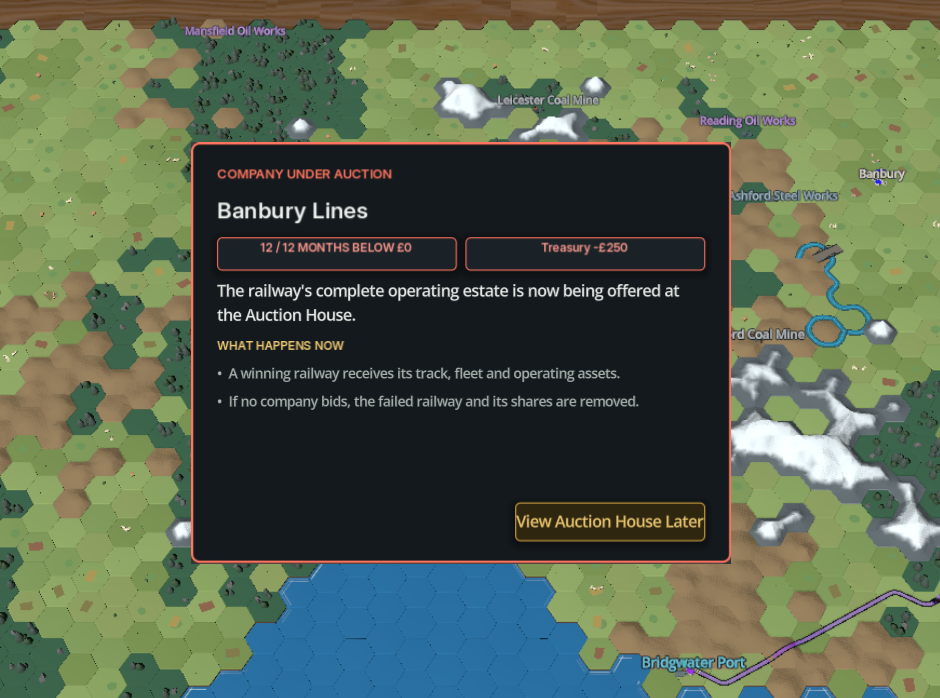
A playtester was playing, everything was fine. Then they entered the auction, which is (to me, at least) a fun diversion from the grueling task of running a railway empire. A freight delivery came up for auction and the player notices that they, too, can sell freight at auctions. Suddenly questions arose, with a cautious statement that the heading elluded to:
- Am I selling my own cargo?
- How much did I pay for it?
- Why would I deliver it if I can just sell it at inflated prices?
- Am I a trader or a hauler in this game?
Now these are very valid questions - questions that a lifetime of playing train games never really stopped me to actually think about. It's natural to me that trains go along, pick stuff up and deliver them, getting paid well for doing so. It's not really natural that we think about whether we as train magnates own the stuff we're hauling around but the one innoculous freight sale option had thrown a spanner in the works of our player's mind.
I could definitely hand wave this one away with talk of abstraction but I started to think about the notion of buying rather than picking up and all the avenues it takes us. This is possibly a more treturous path than I believe it to be.
From Ripples to Pickles
Ok - so, cargo now has a purchase price and the train simply pays that to put the cargo on the train. That's no big deal - we already have a price that places will pay for it, so it makes sense that providers can charge for cargo other than passengers so that's all that's needed, right?
Not so fast! In the next round of my testing companies were going bankrupt within years. The cause was obvious, thanks to cargo capacity at warehouses and factories. Trains were buying cargo, getting to the destination and unloading and with the usual "Keep excess" unticked were simply throwing away precious paid-for coal and steel, then merrily trotting back to buy some more, only to throw it away at the next stop.
So, it seems trivial to simply tick "Keep excess" - but now we have trains full of paid-for cargo who can't switch loads to manufactured products without intervention due to their now full loads of raw materials. The fix? Let's add a pop up to explain what's happened and stop the train. Simple, no?
The result was micro-management feelings and panic to what was a pleasurable experience. Suddenly watching our little trains getting on with everything is interrupted and throws us a difficult decision. Do you re-route the train full of coal - changing its service to find a buyer or forsake the pickup of the next load? To fix this do we somehow allow the sale of coal to places that don't want it? If we allow players to dump it at cost then we trivilise the problem and we've rewarded bad planning. Dumping it at 40% of cost is punishing but gets you out of trouble.
It gets worse. Even the tutorials were bankrupting players or causing confusion. Create a service from a Colliery to the Warehouse delivering coal is a simple task. The default train service options are "Unload, then load" which is pretty harmless I thought - until I saw the results of a train loading back the coal from the warehouse to the colliery who, to be fair, didn't give a great price for their own coal to come back to them. Oh well, Unload, and Load... until we're broke!
Trying to explain to a player this doom-loop in the tutorial can't be healthy. Scaring them into submission isn't going to win us any friends, so the solution, at least for now, is to have sensible service carriage instructions based on what the user probably wants to do. It's not perfect, but we don't punish new players for just accepting defaults any more.
The outcome
Now we have "intelligent" carriage orders, dynamic pricing at each producing site, an actual economy if you like, and opens up the path to haulage contracts where we don't need to own cargo to get paid out.
But, I think this doesn't necessarily shine me in a good light. Perhaps the answer was to be firm with feedback - that we can talk about abstraction, but I feel I might have been pulled towards the lights of more data, more levers to pull, more things to think about. Only time will tell if this is a good decision - or indeed, how long we'll keep charging for cargo...